P&G Scientists Present State of the Art Science for Environmental Fate and Safety Assessment, including Water-Soluble Polymers, at SETAC Europe 2026
May 28, 2026Procter & Gamble (P&G) leading researchers presented at the SETAC (Society of Environmental Toxicology and Chemistry) Annual Meeting last week, contributing to crucial discussions on environmental safety and sustainability.
Their presentations and posters offered valuable expert insights into how cutting-edge science is tackling complex environmental challenges, particularly concerning polymers and their environmental fate. Here's a rundown of what P&G's researchers revealed:
Unraveling the Mystery of Water-Soluble Polymers vs. MicroplasticsOne of the key themes P&G scientists addressed was the critical distinction between water-soluble polymers and microplastics. This is a topic that often causes confusion, so it’s important to build a common understanding of the terms to enable clear dialogue.
Advanced Analytical Techniques to Differentiate Water-Soluble Polymers from Microparticles: Kevin Goodall's presentation, "Distinguishing the Aqueous behaviour of Water Soluble Polymers from Nano-plastics with Advanced Analytical Techniques," highlighted how advanced analytical methods such as Small-Angle X-ray Scattering (SAXS), Dynamic Light Scattering (DLS), and Atomic Force Microscopy (AFM) can differentiate these materials at a molecular level. The takeaway? The study demonstrates water-soluble polymers are not microplastics, and do not have the characteristics of microplastics that lead to environmental issues. Studies and comparison of water-soluble polyvinyl alcohol (PVA), as found in the water-soluble film of detergent pods, and polyethylene glycol (PEG) are not microplastics. Down to the nano or molecular level, both water-soluble PVA and PEG behave fundamentally differently in water to known microplastics like polystyrene and poly(methyl methacrylate) (PMMA), as proven across multiple advanced analytical techniques. All say the same: PVA dissolves fully and consistently, even in stressed environmental conditions like rivers and seas. Detergent grade PVA, like PEG and other water-soluble polymers, does not share any of the environmental risks of microplastics. This distinction is vital for accurate regulatory classification and ensuring appropriate environmental and toxicological tests are applied.
Identifying microparticles, especially those that are unknown or present in low concentrations, is a complex task. Dr. Matt Wagner's presentation, "Identification of Unknowns using Vibrational Spectroscopy - A Case Study of Microparticles in the Environment," delved into this scientific challenge.
The Need for Rigorous Analytical Methods: The rapid growth in microparticle research has, at times, outpaced the development of sufficiently rigorous analytical techniques. This has led to the incorrect identification of microplastics in the environment, food and tissues; contributing to recent media questions and public concern. Lack of rigorous techniques can also hinder appropriate regulatory decision making and leads to lack of reliable and even contradictory findings.
Complexities and Solutions: Identifying microparticles is difficult due to low concentrations, complex matrices, degradation, and contamination risks. While techniques like FTIR and Raman are commonly used, they have limitations in resolution and surface sensitivity. P&G stressed the importance of expert spectral interpretation, better libraries, and multimodal methods to improve identification, especially for weathered or contaminated polymers.
Several P&G presentations underscored the importance of comprehensive and integrated approaches to assessing polymer biodegradation and environmental safety, including references and confirmation of detergent-grade PVA’s biodegradability.
Integrative Assessment of Polymer Biodegradation: Dr. Kathleen McDonough's work focused on developing integrative assessment strategies, bringing together various data points to provide a holistic view, rather than one single data point, of a polymer's environmental fate. Key findings included an established understanding that polymers are complex structures requiring an understanding of the reapplication of existing methods and development of new ones, to accurately assess biodegradation. Ready biodegradation tests can be used as an initial screen, but if a polymer fails to meet these criteria, it does not mean it is not biodegradable- it simply means more investigation is needed. These assays are consistently under-predicting biodegradation of some polymers, due to the known method limitations and conservatism. The importance of improving the environmental realism of polymer biodegradation methods is well recognized: new methods look promising for more accurate screening with a wider applicability domain.
Modeling Polymer Biodegradability: Dr. Susan Csiszar's presentations highlighted the use of modeling tools and transformation pathway data curation to predict and understand polymer biodegradability. This includes "Towards Holistic Approaches to Modeling Polymer Biodegradability," which aims to refine predictive capabilities.
- Demonstration of the Widespread Biodegradation in Wastewater and Natural Environments of PVA:
Multiple studies across various countries, including North America and Europe, consistently show that detergent-grade PVA is biodegraded by microbial communities present in wastewater treatment plants and natural river environments. This applies to many different versions and sizes of soluble PVA.
Comparable to Other Water-Soluble Polymers: The broader presentations and discussion also showed PVA biodegrades just as effectively as other water-soluble and even biobased polymers, such as microcrystalline cellulose.
Evaluating Analytical Tools for Degradation: Dr. Kathleen McDonough also presented on "Evaluating Analytical Tools for Assessing the Degradation of Polysaccharide-based water-soluble polymers," emphasizing the ongoing development and refinement of methods to accurately track degradation.
P&G emphasized the need for comprehensive assessment frameworks for water-soluble polymers. Dr. Maura Hall's presentation, "Integrated Approaches to Assess Bioavailability and Bioaccumulation of Water Soluble Polymers," shed light on this important area.
Moving Beyond Assumptions: Regulators are increasingly seeking concrete mechanistic and empirical evidence for low bioaccumulation conclusions. P&G's work outlined a robust "weight-of-evidence" approach, drawing on current regulatory approaches and reviews from around the worlds, combined with a mechanistic understanding of the drivers for bioaccumulation. This framework combines factors like size, solubility, toxicokinetics, and empirical data to provide a strong and reliable assessment.
Water Soluble Polymers and Detergent grade PVA: A Case Study in Low Bioaccumulation: Applying the body of evidence approach, we could show detergent-grade PVA consistently demonstrates low bioaccumulation potential and, under this body of framework, should not be considered bioaccumulative, and will struggle to cross biological membranes. This framework can be reapplied to other water-soluble polymers.
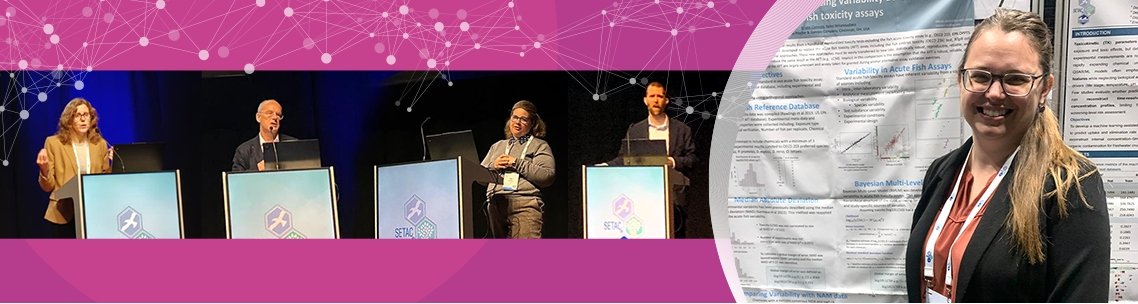
Dr. Kristin Connors’ poster, “From Variability to Validation: A Bayesian Approach for Evaluating Alternative Fish Toxicity Tests,” looked at how to expand methodologies for determining ingredient toxicity effects. This is critical work to continue to advance alternative approaches at the cutting edge of modelling science, ensuring scientific robustness and rigor.
The Importance of Understanding Underlying Variability: There is a need to understand the underlying variability of standard assays in order to support the development and validation of alternative approaches. Here, data-driven approaches were used to characterize the underlying variability in the in vivo OECD 203 acute fish toxicity assay.
Data to Support Scientific Credibility: This data-driven approach offers a transparent and statistically sound basis for assessing the reliability of New Approach Methodologies (NAMs) and guiding future validation and regulatory decision-making. The results from alternative tests, such as the fish embryo toxicity assay (FET; OECD 236) and the RTgill assay (OECD 249), generally fall within the established variability range of AFT, supporting their scientific credibility.
This critical work is also being expanded with other partners around the world.
The Broader Context: Communication and Scientific IntegrityBeyond the technical presentations, experts also contributed to discussions on the critical importance of clear scientific communication and maintaining trust in science.
Addressing Misconceptions about Biodegradation Tests: Dr. Drew McAvoy's work, "Screening Biodegradation Tests: History, Predictive Value, and Clarification of Common Misconceptions in Environmental Persistence Assessment," aimed to clarify misunderstandings about biodegradation tests. He highlighted that "Ready" tests are conservative screening tools, using up to 2500x higher substance-to-microbe ratio and unacclimated microbes, and therefore a result of 60% biodegradation within 28 days in these tests strongly predicts fast biodegradation – often within hours – in real systems. Additionally, he indicated that tiering tests can be done to get closer to environmental conditions. He also addressed common misperceptions, such as the idea that negative "Ready" results equate to persistence or that wastewater treatment plants cannot degrade polymers. He explained biodegradation produces energy, CO2, and biomass in the microbes – hence why not all metabolized carbon is emitted as CO2. He closed with explaining why a 60% CO2 pass criterion in a lab result equates to near total removal in real world systems.
Navigating the "Post-Truth" Landscape: Dr. Scott Dyer's presentation, "Implications of Post-Modern, Post-Truth Philosophies and the Dunning-Kruger Effect to Micro-Nano-Plastic Environmental Risk Communication," tackled the challenging topic of declining trust in science. He argued that the issue extends beyond bad research practices to a broader "post-truth" mindset where emotions and beliefs can overshadow objective facts. He emphasized that in complex fields like microplastics and polymer science, clear, precise communication and education are essential to protect scientific credibility and support sound decisions.
In essence, P&G's presence at SETAC 2026 showcased our commitment to robust scientific inquiry, transparent communication, and continuous innovation in understanding and managing the environmental impact of our products. For those interested in the cutting edge of environmental science, their contributions offer valuable insights and a hopeful outlook for a more sustainable future. Academic, industrial, and regulatory collaboration is vital to scientific rigor and advancement, and we look forward to contributing and developing it further.
Interested to learn more about the science of biodegradation? Read about the Cascade Dishwashing Smart Film or The Science behind our Ariel All-in-1 PODS® to see how this science comes to life for a superior clean you can trust.
References:Unraveling the Mystery of Water-Soluble Polymers vs. Microplastics:
Agostiniano, G., et al. (2025). Defining the conformation of water soluble polyvinyl alcohol in solution: A SAXS, DLS and AFM study. ACS Omega. DOI: 10.1021/acsomega.5c00692. Available at: https://doi.org/10.1021/acsomega.5c00692
Agostiniano, G., et al. (2025). Defining the conformation of water soluble polyvinyl alcohol in solution: A SAXS, DLS and AFM study. ACS Omega. DOI: 10.1021/acsomega.5c00692. Available at: https://doi.org/10.1021/acsomega.5c00692
Bao, L., et al. (2002). Bound water governs the single-chain property of Poly(vinyl alcohol) in aqueous environments. Polymer. DOI: 10.1016/j.polymer.2022.124996. Available at: https://doi.org/10.1016/j.polymer.2022.124996
Almasy, L., et al. Structure and Intermolecular Interactions in Aqueous Solutions of Polyethylene Glycol. Molecules, 27(8), 2573. Available at: https://www.mdpi.com/1420-3049/27/8/2573
Integrated Approaches to Assessing Bioavailability and Bioaccumulation:
Arnot, J. A., & Gobas, F. A. P. C. (2006). A review of bioconcentration factor (BCF) and bioaccumulation factor (BAF) assessments for organic chemicals in aquatic organisms. Environmental Reviews, 14(4), 257–297. https://doi.org/10.1139/A06-005
European Chemicals Agency (ECHA). (2017). Guidance on information requirements and chemical safety assessment: Annex XI – Waiving of standard testing. ECHA.
European Chemicals Agency (ECHA). (2024). Key areas of regulatory challenge. ECHA.
Philipsen, E. K., Batsberg, W., & Christensen, A. B. (1988). Gastrointestinal permeability to polyethylene glycol: An evaluation of urinary recovery of an oral load of polyethylene glycol as a parameter of intestinal permeability in man. European Journal of Clinical Investigation, 18(2), 139–145. https://doi.org/10.1111/j.1365-2362.1988.tb02404.x
Sanders, L., & Matthews, H. B. (1990). Vaginal absorption of polyvinyl alcohol in Fischer 344 rats. Human & Experimental Toxicology, 9(3), 147–157. https://doi.org/10.1177/096032719000900301
U.S. Environmental Protection Agency (EPA). (2023). TSCA Section 21 petition response for polyvinyl alcohol (PVA). Federal Register, 88, 74215–74222. https://www.federalregister.gov/documents/2023/04/27/2023-08864/polyvinyl-alcohol-pva-tsca-section-21-petition-for-rulemaking-reasons-for-agency-response-denial-of
Université catholique de Louvain (UC Louvain). (2024). Octanol solubility method development for detergent-grade poly(vinyl alcohol). Louvain-la-Neuve, Belgium (to-be published)
Tackling the Challenges of Microparticle Identification:
Lim et al, Reducing Spectral Confusion in Microplastic Analysis: A U-Net Deep Learning Approach Anal.Chem.2025,97,18432−18443; https://doi.org/10.1021/acs.analchem.5c00584
Hossain et al, RSC Environ. Sci.: Nano, 2026, 13, 12 A comprehensive toolkit for micro- to nanoplastic analysis. https://pubs.rsc.org/en/content/articlelanding/2026/en/d5en00856e
Umuhan et al, Applications of Raman spectroscopy for microplastic detection and characterization: a comprehensive spectral reference Environmental Science and Pollution Research (2025) 32:28630–28677 https://link.springer.com/article/10.1007/s11356-025-37224-3
Towards Holistic and Integrative Assessments of Polymer Biodegradation:
Menzies, J., Wilcox, A., Casteel, K., McDonough, K. (2023). Water-soluble polymer biodegradation evaluation using standard and experimental methods. Science of the Total Environment, 858 (Part 3), 160006. https://www.sciencedirect.com/science/article/pii/S0048969722071066
McDonough, K., et al. (2023). Multi-laboratory evaluation of the reproducibility of polymer biodegradation assessments applying standardized and modified respirometry methods. Science of the Total Environment, 901, 166339. https://www.sciencedirect.com/science/article/pii/S0048969723049641
McDonough, K., Hall, M., Wilcox, A., Menzies, J., et al. (2024). Application of standardized methods to evaluate the environmental safety of polyvinyl alcohol disposed of down the drain. Integrated Environmental Assessment and Management, 20(5), 1693–1705. https://onlinelibrary.wiley.com/doi/10.1002/ieam.4929
Wilcox A, Hall M, Menzies J, Yates N, Neal T, Isaacs S, Price J, Sun Y, Stilianoudakis S, Sivik M, McDonough K. 2025. Carboxymethyl cellulose biodegradation by activated sludge microbial communities. Sci Tot Environ. 991. 179942. https://www.sciencedirect.com/science/article/pii/S0048969725015827
C. Lin and H. Zhang. Polymer Biodegradation in Aquatic Environments: A Machine Learning Model Informed by Meta-Analysis of Structure-Biodegradation Relationships, ES&T, 2025 59 (2),1253-1263. https://pubs.acs.org/doi/10.1021/acs.est.4c11282
Kuenneth et al. (2021) Copolymer Informatics with Multitask Deep Neural Networks Macromolecules, 54, 5957−5961; 10.1021/acs.macromol.1c00728
Strotmann, Heipieper, Eberlein, Mayer, Birch, Gartiser, Pagga, Daturpalli, Battagliarin, McDonough & Thouand. 2026. Testing the biodegradability of difficult compounds: a future challenge for the OECD/ISO standardization. Applied Microbiol Biotech. 110: 122. https://link.springer.com/article/10.1007/s00253-026-13798-x
The Broader Context: Communication and Scientific Integrity:
Federle, Gasior & Nuck (1997); Extrapolating mineralization rates from the ready Co2 screening test to activated sludge, river water, and soil Environmental Toxicology and Chemistry, 16, 127–134. https://doi.org/10.1002/etc.5620160205
Struijs, J., van den Berg, R., 1995. Standardized biodegradability tests: extrapolation to aerobic environments. Water Res. 29 (1), 255–262.;
Zumstein, M. T., Battagliarin, G., Kuenkel, A., & Sander, M. (2022). Environmental biodegradation of water-soluble polymers: Key considerations and ways forward. Accounts of Chemical Research, 55(16), 2163–2167. https://doi.org/10.1021/acs.accounts.2c00232
Boethling, R., Howard, P.H., Beauman, J.A., Larosche, M.E., 1995. Factors for intermedia extrapolation in biodegradability assessment. Chemosphere 30 (4), 741–752.
Painter H (1995) Detailed review paper on biodegradability testing. OECD Series on the test guidelines programme. Environment monograph No. 98. OECD Paris https://one.oecd.org/document/ocde/gd(95)43/en/pdf)
Guhl, W., et al. (2006). The value of biodegradation screening test results for predicting the elimination of chemicals’ organic carbon in wastewater treatment plants. Chemosphere, 63(1), 9–16.
Stroman, T., et al. (2023). Toward the future of OECD/ISO biodegradability testing—new approaches and developments. Applied Microbiology and Microtechnology, 107, 2073ff.
Davenport R. et al. 2002. Scientific concepts and methods for moving persistence assessments into the 21st century. Integrated Environmental Assessment and Management, 18(6): 1454–1487. https://doi.org/ 10.1002/ ieam.4575
OECD. 2006. OECD Guidelines for the Testing of Chemicals, Revised Introduction to the OECD Guidelines for Testing of Chemicals, Section 3, Part 1: Principles and Strategies Related to the Testing of Degradation of Organic Chemicals. Available from: https://www.oecd-ilibrary.org/ environment/ revised-introduction-to-the-oecd-guidelines-for-testing-of-chemicals-section-3_ 9789264030213-en#page1.